


Yes, you can often recover the cost of pothole tyre damage, either from the road authority responsible for that stretch of tar or through your own insurer, but you need to pick one route and start gathering evidence the moment it happens. SANRAL handles national routes, municipalities handle local roads, and the proof you collect in the first hour decides whether your claim goes anywhere. A tyre and rim plan can also soften the blow while you wait for an outcome.
TL;DR:
- Photograph the pothole with nearby landmarks and close details, record the time and GPS location, retain the damaged tyre and rim, and collect witness details and repair invoices.
- Send the claim first to the responsible authority: SANRAL handles national routes, provincial departments handle provincial roads, and municipalities manage local roads.
- Public liability claims generally require three independent repair quotes, photos, a location sketch, and supporting documents; claims against state bodies also face strict notice deadlines.
- Reporting the pothole immediately and keeping its reference number strengthens a public liability claim, while prior notice makes rejection harder for the authority.
- Insurer claims can be faster but may involve an excess and affect your bonus; authority claims avoid those costs but take longer.
Table of Contents
- What to do immediately after hitting a pothole: the evidence pack
- Who to claim from: mapping SANRAL, provincial departments and municipal responsibility
- How to file a public liability claim step by step: forms, documents and timing
- Insurer vs road authority: how to decide which route to take
- How Motor Plan Direct can help protect you from pothole repair costs
- A practitioner’s view on improving your claim odds
- Check your cover options and get a free quote
- FAQ
- Sources
What to do immediately after hitting a pothole: the evidence pack
Your car just made a noise you didn’t like, and your instinct is to keep driving. Don’t. Pull over somewhere safe first, then start building your case like you mean it.
-
Photograph the pothole from a distance so the road and nearby landmarks are visible, then move in close for detail shots of depth and edges.
-
Take a photo of your dashboard clock or your phone’s lock screen next to the pothole so the time is beyond dispute.
-
Photograph every angle of the damage: tyre sidewall tears, rim dents, and anything that looks off underneath the car.
-
Drop a pin or screenshot your maps app so the GPS location is saved, not just remembered.
-
Keep the damaged tyre and rim rather than binning them. An assessor may want to inspect the original parts, and “it looked bad” doesn’t hold up as well as the actual tyre does.
Pro Tip: Store the damaged tyre somewhere dry and out of the weather until your claim is resolved. A soggy, sun-bleached exhibit helps nobody.
Beyond photos, a few more things strengthen your position considerably:
- Get contact details from any witnesses who saw the impact.
- Ask for a police affidavit if the damage is severe or if you suspect you’ll need one for an insurer.
- Collect towing and repair invoices as they come in, and get three independent repair quotes rather than settling for one.
- Report the pothole itself to the relevant portal (your municipality’s fault line or SANRAL’s reporting channel) and keep the reference number. That number is your proof the authority knew about the hazard.
Who to claim from: mapping SANRAL, provincial departments and municipal responsibility
Working out who actually owns the road matters more than most drivers realise, because the wrong form sent to the wrong office wastes weeks you don’t have.
- National routes such as the N1, N2, N3, N11 and N14 fall under SANRAL’s responsibility, so damage on these roads goes through SANRAL’s own claims process.
- Provincial roads, including many R-numbered routes, are handled by your province’s Department of Roads and Transport.
- Metro roads fall to agencies like the Johannesburg Roads Agency, while other metros, including Ekurhuleni, run their own public liability claim desks with their own forms.
Getting this right isn’t a technicality. It determines which form you fill in, where you send your evidence pack, and whether your insurer’s subrogation team even knows who to chase afterwards. If you’re not sure which authority owns the road, a quick call to your local municipality’s roads department will usually clear it up faster than guessing.
How to file a public liability claim step by step: forms, documents and timing
Once you know who’s responsible, the process itself is fairly mechanical, provided you have your paperwork in order.
Start by downloading the correct form. The City of Ekurhuleni’s public liability claim form for pothole damage is a useful template even if you’re claiming elsewhere, since most municipal and provincial forms ask for broadly the same things. The Gauteng Department of Roads and Transport’s claim form follows the same pattern, requesting multiple photos and a sketch of the scene.
Your documents checklist typically includes:
- A certified copy of your ID and driving licence.
- Your vehicle registration details.
- Three independent repair quotations.
- Photos of the pothole and the damage, plus a sketch of the location.
- A police affidavit if you have one, proof of insurance or an affidavit confirming you have none, stamped banking details, and any witness statements.
Submission is usually by email or online upload, though some offices still accept documents in person. Once lodged, an assessor reviews the merits of the claim, which can take weeks rather than days, so follow up periodically and keep your reference number handy for every call.
Here’s a figure worth knowing before you file: claims involving a pothole that had already been reported are harder for the authority to reject, since a prior report puts the authority on formal notice of the hazard.
There’s also a legal clock running. Claims against organs of state generally require a notice served within strict time limits under the Institution of Legal Proceedings Against Certain Organs of State Act 40 of 2002, so don’t sit on this for months while you decide whether it’s worth the hassle.
Insurer vs road authority: how to decide which route to take
Both routes can work, but they suit different situations, so weigh them before you commit to one.
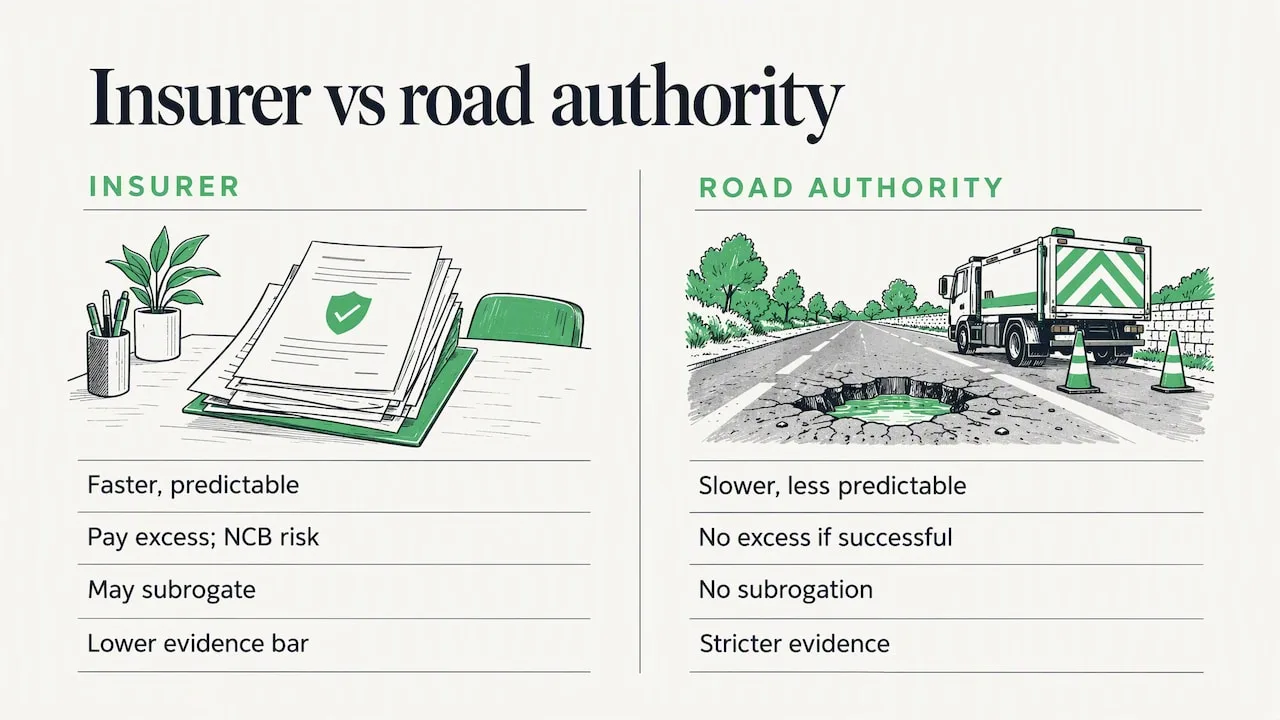
Going through your insurer tends to be faster and more predictable, though you’ll likely pay your excess and risk a dent to your no-claim bonus. Your insurer may also subrogate, meaning it pursues the road authority on your behalf after paying you out, which can recover some of that excess later.
Claiming directly from the authority avoids the excess and bonus hit entirely if successful, but expect a longer wait, stricter evidence standards, and a real chance of rejection if your documentation has gaps.
Pro Tip: Notify your insurer early even if you plan to claim from the authority first. It keeps your options open and avoids disputes over timing later.
A quick gut check helps: compare your repair cost to your excess, rate the strength of your evidence honestly, and factor in how urgently you need the car back on the road. Large sums, injury, or an outright rejection are good reasons to get legal advice before going further.
How Motor Plan Direct can help protect you from pothole repair costs
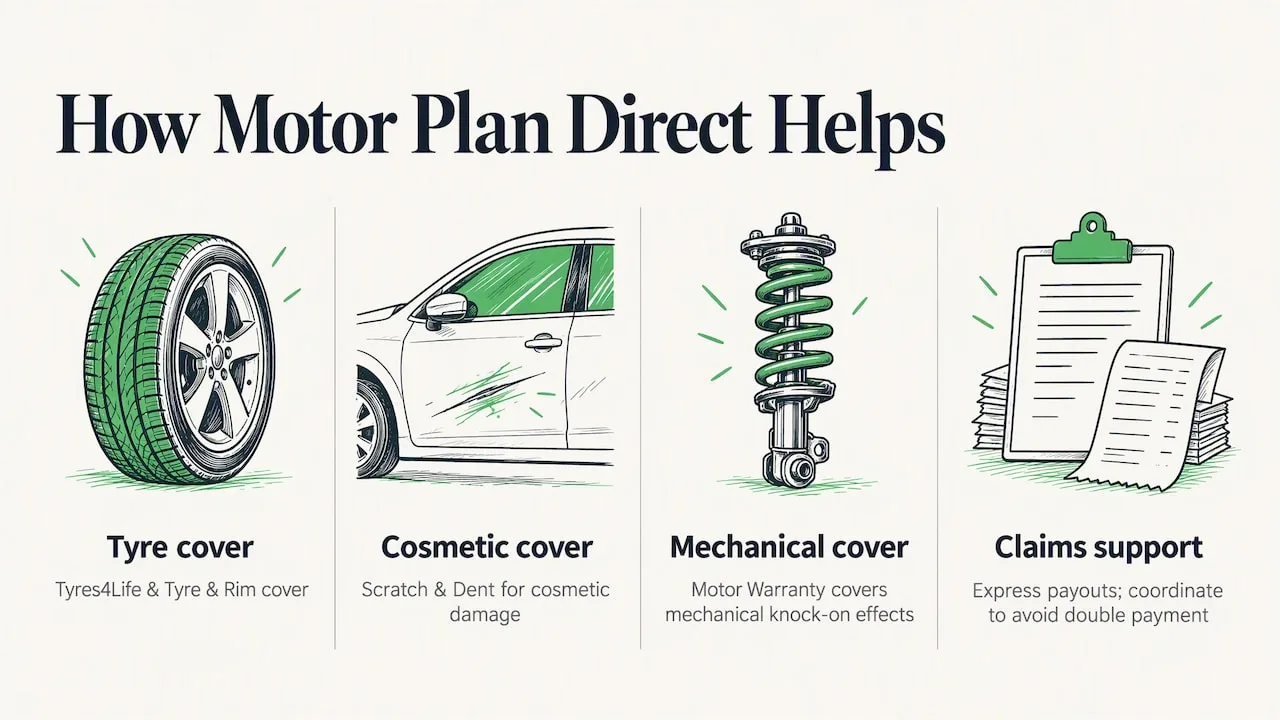
We built Tyres4Life and Tyre & Rim cover specifically for moments like this, so a pothole doesn’t turn into a bill you weren’t planning for. Scratch & Dent cover handles cosmetic damage from the same incident, and our Motor Warranty picks up mechanical knock-on effects like suspension strain. We process claims aiming for express payouts, so you’re not funding the wait yourself. If you also claim from an insurer or authority, keep us in the loop, hold onto your documents, and we’ll coordinate so nobody pays twice.
A practitioner’s view on improving your claim odds
The single biggest difference between a paid claim and a rejected one is evidence quality, gathered on the day, not reconstructed from memory a week later. Report the pothole immediately, keep the damaged parts, and resist the urge to settle for one hasty repair quote. The three mistakes we see most: binning the tyre before inspection, waiting too long to report, and sending a claim to the wrong authority entirely.
— Jurie
Check your cover options and get a free quote
Pothole damage is one of those costs nobody budgets for, which is exactly the gap Tyres4Life and Tyre & Rim cover are built to close.

Have a look at what’s included, check the specifics around tyre and rim claims, and get a personalised quote before your next pothole finds you first.
This article is general information, not a substitute for advice from a qualified lawyer. Consult a qualified legal professional about your own circumstances before acting on anything here.
FAQ
Can I claim damages from potholes in South Africa?
Yes, you can claim from the responsible road authority, whether that’s SANRAL, a provincial department, or your municipality, provided you can show the authority had notice of the pothole and failed to repair it. Success depends heavily on the strength of your evidence pack and meeting the statutory notice period under the Institution of Legal Proceedings Against Certain Organs of State Act 40 of 2002.
Can you claim for damage done by potholes?
Yes, both the road authority and your comprehensive insurer are potential routes, though each comes with different trade-offs around excess, timing, and rejection risk. Many drivers also hold tyre and rim cover to reduce out-of-pocket costs while a claim is still being assessed.
Can I file a claim with the JRA for pothole damage?
Yes, the Johannesburg Roads Agency runs its own public liability claim process for vehicle damage within the city, with forms and instructions available on its site. You’ll still need the usual evidence pack, including photos, repair quotes, and proof of the pothole’s location.
Is it illegal to fix potholes in South Africa?
Road maintenance, including pothole repairs, is the legal responsibility of whichever authority owns that stretch of road, be it SANRAL, a province, or a municipality. Individuals filling potholes themselves isn’t typically framed as a criminal act, but it isn’t a substitute for reporting the hazard through the correct official channel, which also protects your ability to claim later.
Sources
- City of Ekurhuleni public liability claim form (potholes)
- How to claim for pothole damage to your vehicle — provincial media release referencing SANRAL responsibility
- CLAIM FOR PUBLIC LIABILITY – The JRA
- Hit a pothole? Here’s how to claim for your vehicle damage in South Africa — Visagie Vos Inc.
- Gauteng Department of Roads & Transport claim form (2018)